


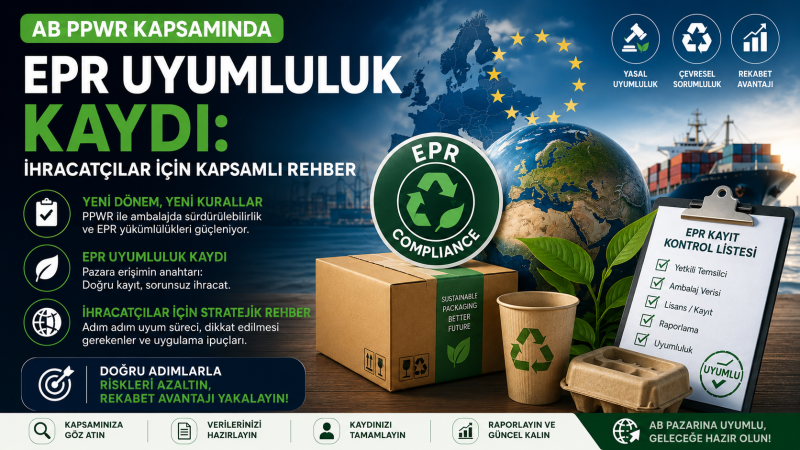
The rules for companies exporting to the European Union (EU) are fundamentally changing. The European Union Packaging and Packaging Waste Regulation (PPWR) is transforming sustainability from a recommendation into a strict legal obligation. At the center of this transformation lies one of the most pressing concerns for exporters: EPR (Extended Producer Responsibility) Compliance Registration.
Companies engaged in B2B (business-to-business) exports, particularly in sectors such as automotive, machinery, and heavy industry, must now assume legal responsibility for the transport packaging they use. At Arkas Ambalaj, with our industry experience, we view this complex process not merely as a legal obligation, but as a strategic step that, when managed correctly, can create a significant cost advantage.
So, what exactly is EPR compliance registration, and how does it affect your export processes?
What is EPR (Extended Producer Responsibility)?
EPR is an environmental policy that places the financial and physical responsibility for the environmental impacts occurring at the end of a product's or packaging's life cycle onto the party that introduces it to the market.
Under the PPWR, the costs required for the collection, sorting, and recycling of every piece of packaging entering the EU market must be guaranteed upfront by the exporting or importing company. This system is based on the "polluter pays" principle.
Key Steps in the EPR Compliance Registration Process
EPR registration is not a one-time paperwork task; rather, it is a data and cost system that requires continuous management. The process generally operates as follows:
1. Registration in National Databases and Identification Number
Every EU country that your packaged product enters has its own national database (e.g., LUCID in Germany, SYDEREP in France). Companies are required to register in these systems to obtain a Unique Identification Number (UIN) for EPR. This number must be included on customs declarations, B2B commercial invoices, and transport documents.
2. Appointing an Authorized Representative
Companies not established within EU borders (e.g., manufacturers exporting directly from Türkiye) must appoint an official "Authorized Representative" in most EU countries to handle their EPR registrations. This representative assumes legal responsibility on your behalf.
3. Contracting with a PRO (Producer Responsibility Organization)
Following registration, it is mandatory to enter into an agreement with authorized Producer Responsibility Organizations (PROs) that organize the physical collection and recycling of packaging waste.
4. Periodic Tonnage Declaration and Eco-Modulation
This is the most critical stage. The material type and tonnage of the packaging you place on the market must be declared periodically. This is where Eco-modulation comes into play. The EPR contribution fee you pay varies depending on whether your packaging is environmentally friendly.
| Packaging Type | Recyclability | EPR Cost Impact |
|---|---|---|
| Pure Cardboard / Paper-Based | 100% (Easy) | Lowest Tariff (Advantageous) |
| Mixed Materials | Partial (Difficult/Costly) | High Tariff (Penalized) |
| Non-Recyclable Plastics | Impossible / Very Difficult | Highest Tariff (Penalized) |
The EN 13430 Standard and the Role of Industrial Packaging
Wooden crates, plastic pallets, or mixed-material transport systems used in exports face high EPR costs and heavy customs inspections. This is where the technical dimension of the process comes into play: the EN 13430 (Requirements for packaging recoverable by material recycling) standard.
Designing packaging in compliance with the EN 13430 standard and proving this with technical documentation is the only way to minimize EPR costs. Major buyers, particularly in the automotive main industry, have begun demanding not only the goods but also the PPWR compliance analysis of the packaging from their suppliers.
Honeycomb panels, cardboard pallets, and edge protectors manufactured using kraft paper and natural adhesives provide the greatest advantage in the eco-modulation system due to their 100% recyclable structures. By transitioning from heavy, difficult-to-recycle materials to lightweight, recyclable cellulosic structures, businesses can both reduce freight costs and avoid EPR penalties in Europe.
Managing Risks and Building the Right Infrastructure
PPWR compliance is not a process that can be resolved solely by a customs broker or an accounting department. It is an engineering and data management issue that spans from the production line of the packaging used to the recycling facility in the EU. Every detail, from the grammage and components of the packaging to the printing ink and design, directly affects the EPR tax to be paid.
At Arkas Ambalaj, with our deep technical expertise in industrial transport systems, we believe that packaging is not merely a protection tool, but a strategic competitive element in international trade. Every innovative solution that leaves our facilities is designed to meet the rigorous demands of global regulations.
Minimizing packaging-related regulatory risks in exports to Europe, correctly structuring EN 13430 technical documentation requirements, and developing structural solutions that will turn your EPR obligations into a competitive advantage requires serious industrial packaging engineering. To evaluate technical details and specific case studies on how to prepare your systems for the future during this critical transition period, you can contact our expert engineering staff.