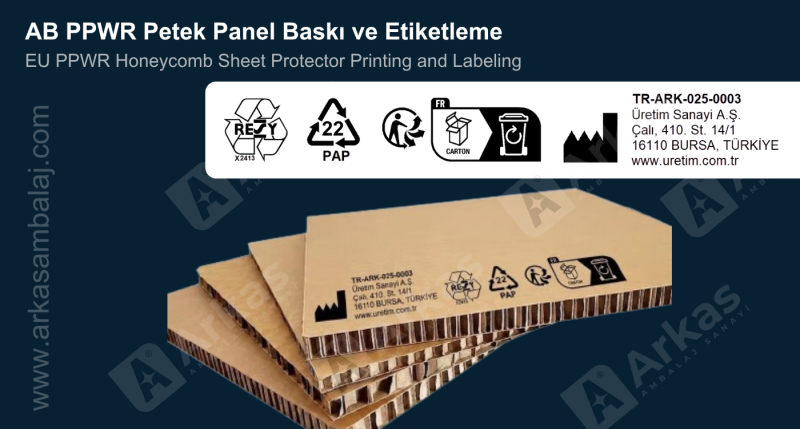
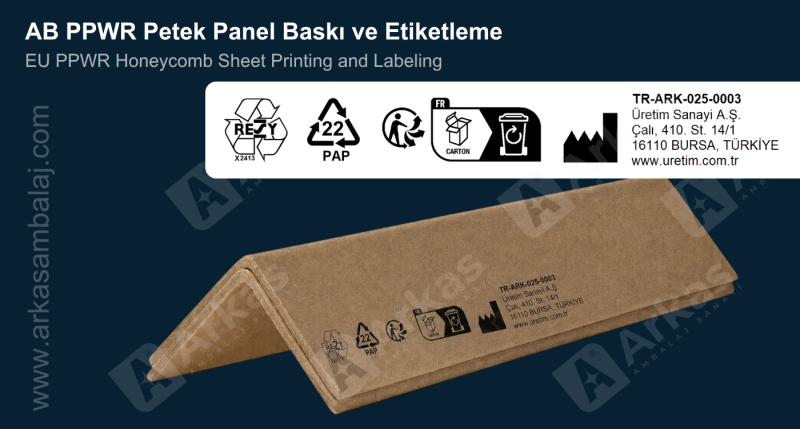
EU PPWR: Paper Honeycomb Board Labeling and Printing Standards
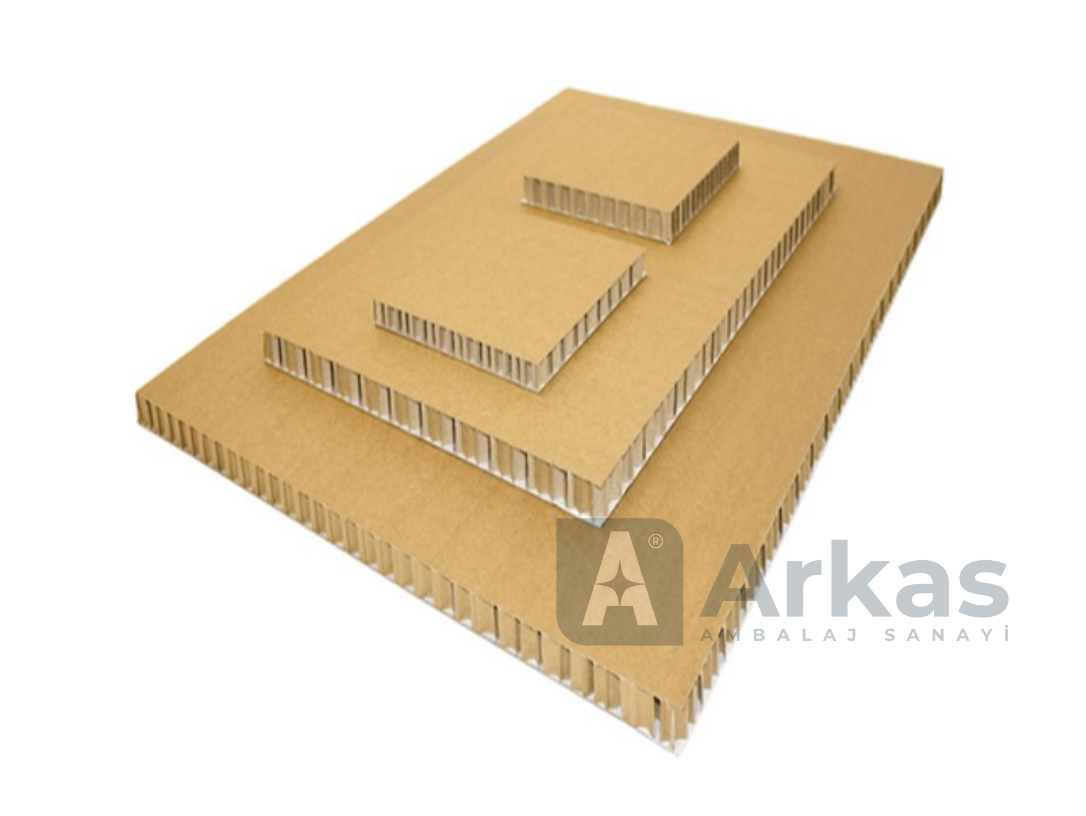
In the PPWR compliance agenda of companies exporting to the European Union, the export carton and edge protectors usually take center stage. However, the paper honeycomb board, which is included in the same shipment, is defined as "packaging" under the PPWR (Packaging and Packaging Waste Regulation) and is subject to the exact same printing, marking, and traceability obligations as the export carton.Despite its light weight and simple appearance, the paper honeycomb board is a technical packaging component that falls under independent scrutiny in EU customs inspections. A honeycomb board lacking the required PPWR markings can solely constitute grounds for non-compliance, even if the export carton in the same shipment fully meets all requirements.This guide has been prepared for companies exporting to the European Union or preparing to enter this market, as well as packaging procurement managers, to fully understand at a technical level the PPWR requirements applicable to kraft paper-based brown paper honeycomb boards.What is PPWR and Why Does It Directly Affect Paper Honeycomb Boards?PPWR is a new-generation regulation that replaces the EU's former Packaging Directive 94/62/EC. Unlike a directive, a regulation does not wait to be transposed into the national legislation of member states; it applies directly and uniformly in all member countries the moment it enters into force. For every exporter entering the EU market from Turkey, this means a uniform and mandatory compliance obligation.The regulation aims to increase recycling rates, reduce packaging waste, and embed circular economy principles into every link of the supply chain. In this context, the paper honeycomb board is considered beyond a mere buffer, divider, or support element—it is treated as a technical packaging component that carries identification information, provides traceability, and contributes to the recycling system.Which Packaging Category Does Paper Honeycomb Board Fall Into?PPWR defines packaging according to functional categories:Primary packaging: Packaging in direct contact with the product.Secondary packaging: Grouping packaging that holds primary packages together.Tertiary / Transport packaging: Any packaging component that protects products from damage during handling and storage.Although paper honeycomb boards can fall into different tiers of this classification depending on their usage area, their most common functions in export shipments are:Pallet divider (layer pad): Placed between pallet layers to prevent products from damaging each other.Buffer and filler panel: Protects the product from impact by filling the voids inside the carton.Support and base board: Provides structural support at the pallet base or under the product.Edge and surface protection panel: Protects the edges and surfaces of large-area products.In all these usage forms, the paper honeycomb board falls under the scope of tertiary packaging. The definition in Article 3 of the PPWR clearly covers these functions.Practical outcome: The moment the paper honeycomb board enters EU customs, it is subject to the same regulatory inspection as the export carton.The Material Identity of Paper Honeycomb Board: 22 PAPThe paper honeycomb board discussed in this guide is a fully paper-based composite panel material consisting of a kraft paper-based honeycomb core and kraft paper surface linings (liners). Its brown color is the characteristic color of unbleached natural kraft paper.In the standard coding system established by the European Commission for packaging materials, this structure, which consists predominantly of paper-based material, is identified by the 22 PAP code.MaterialCodeAbbreviationApplication AreaCorrugated Board20PAPExport cartonSolid Board21PAPCardboard edge protectorKraft Paper / Paper Honeycomb Board22PAPPaper honeycomb board (standard)Technical Note: The material code of the paper honeycomb board may vary depending on the raw material composition. If board is used for the surface linings (liners), the code can also be applied as 21 PAP. Which code to use should be determined and documented by the manufacturer based on the raw material certificate. Arkas Packaging matches the raw material certificate with the code allocation for each production batch, providing proof to the exporter.PPWR Article 15 and Article 18: Core Compliance FrameworkThe two primary articles that directly regulate the printing and marking requirements on the paper honeycomb board are:Article 15 — Packaging Information: All information and symbols on the panel must remain legible, indelible, and verifiable throughout the component's lifecycle—from production and transport to storage and the recycling facility. This information must be resistant to physical conditions such as humidity, pressure, friction, and temperature changes in logistics processes.Article 18 — Traceability and Identification: The panel must bear a unique identification number that enables traceability and must include information identifying the manufacturer or importer. This article establishes an unbreakable link between the packaging component and the economic operator placing it on the market.When both articles are evaluated together, the resulting picture is clear: The paper honeycomb board must be designed during the production process regarding the permanence and accuracy of the information it carries.Physical Printing Rules: Material, Color, and FontThe physical standards for prints on the paper honeycomb board share the same parameters as other paper-based packaging components:ParameterMandatory StandardBase MaterialThe natural brown kraft paper surface of the panelPrint ColorBlackFontArialLegibilityIndelible throughout the entire lifecycleThe fundamental reason for these rules is practical: Black Arial print on a brown kraft surface provides maximum legibility for optical character recognition (OCR) systems in recycling facilities and manual barcode scanner readings. Different color or font combinations lead to scanning errors, thereby breaking the traceability chain.In this regard, the brown kraft surface of the paper honeycomb board has the same optical qualities as the natural brown background of the export carton; black print naturally meets standard requirements in terms of contrast and legibility.PPWR Article 15 and 18 Compliance: Print Durability and Avoiding LabelsArticles 15 and 18 of the PPWR mandate that the information on the packaging component remains legible throughout its entire lifecycle. At this point, a critical technical decision emerges: Using adhesive labels is a highly risky method for meeting the durability requirements of the PPWR.Due to its structural characteristics, the paper honeycomb board is subjected to unique conditions that make this risk even more prominent:Surface porosity: The natural porous structure of kraft paper leads to uneven penetration of the label adhesive, causing weak adhesion at the edges of the label.Pallet stretch film pressure: The stretch film applies uneven pressure to the panel surface. The honeycomb voids beneath the panel locally increase this pressure, curling or peeling the label off.Container and warehouse humidity: The moisture cycle in maritime transport, combined with the moisture-absorbing property of kraft paper, weakens the label adhesive; the label can lift off the surface.Static pressure and friction: The panel is exposed to friction caused by the weight and movement of the products within the pallet; these conditions can mechanically destroy the label.Cold chain conditions: In condensation environments, the bond strength of the label adhesive decreases, and the label surface blisters.During a customs inspection, any of these damages directly translates into a non-compliance report on the grounds of an "illegible marking."Arkas Packaging's Technical Approach:Instead of a label, direct printing is applied to the kraft paper surface of the panel using high-strength water-based black ink.Prints are tested using industrial protocols such as ASTM D5264 (Sutherland rub test) and ISO 18947 (abrasion resistance).The legibility of the print throughout all logistics processes is verified and documented through humidity chamber tests (95% humidity, 48 hours at 40°C), static load tests, and drop tests (ISTA 1A).For each batch of paper honeycomb boards, these tests are conducted in Arkas Packaging's own laboratory or at accredited external facilities, and a certificate of conformity is issued to the exporting company.Why Direct Print Instead of Labels?The surface structure of kraft paper and the internal structure of the paper honeycomb board make the use of labels physically problematic. Furthermore, the PPWR's principle of avoiding unnecessary chemicals adopts direct printing as the fundamental approach.Basic Rules and Why Labels Are ExcludedColor — Black Only: Colored labels or labels with pigmented inks disrupt the de-inking process during recycling. By using water-based black ink, Arkas Packaging ensures 100% recovery of the paper pulp.Font — Arial or Sans-serif: Even if the correct font is used on the label, the font requirement is considered violated if the label detaches from the kraft surface. In direct printing, the font is an inseparable part of the material.Adhesive Contamination: Acrylic or hot-melt adhesives used in labels cause contamination in the recycling pool. PPWR Annex II (Recyclability Criteria) restricts such adhesives.Pressure distribution of the honeycomb structure: The label affixed to the panel is suspended in the air over the void areas of the honeycomb cells; adhesion only occurs at the top points of the cell walls. This can effectively reduce the surface adhesion area of the label down to 30-40%.Arkas Packaging's Testing and Approval ProcessesRub Test: Using a Sutherland rub tester with 2 kg pressure, print loss must be ≤ 5% after 10 double strokes.Scotch Tape Test (ASTM D3359-Method B): The print's adhesion resistance to the surface must be at a 4B or 5B level.Damp Rub Test: There must be no bleeding or smearing of the print in condensation environments.UV Fading Test (ISO 12040): Color change ΔE ≤ 1.5 after 24 hours under a Xenon lamp.Application Note: In flexo or digital printing technologies, ink penetration and density must be adjusted according to the absorbency characteristics of the paper honeycomb board's kraft paper surface. Ink viscosity and printing speed are production variables that need to be calibrated according to surface roughness and porosity parameters. This falls under the technical responsibility of the packaging manufacturer.Outer (Top) Surface Printing RequirementsThe outward-facing surface of the paper honeycomb board—the kraft paper surface that is visibly positioned within the shipment or on the pallet—is the primary area where logistics and regulatory identity are carried. Under the PPWR, it is mandatory to have the following elements fully present on this surface:1. Exporter / Manufacturer Company Identification DetailsThe company's full commercial address (at the street, city, and country level).Website address and/or other digital communication channels.(This information is mandatory so that EU customs authorities and market surveillance bodies can quickly identify the economic operator placing the product on the market.)2. ISO 7000 Series SymbolsEU legislation mandates the use of international graphical symbols to identify the entity placing the packaging component on the market:ISO 7000-3082 Symbol: Used by the company that actually manufactures the paper honeycomb board (Manufacturer).ISO 7000-3725 Symbol: Used by the company that introduces the paper honeycomb board to the EU market but does not manufacture it itself (Importer).Every exporter must use only one of these two symbols, depending on their role in the supply chain. Using both together or selecting the wrong symbol constitutes direct grounds for non-compliance.3. Unique Packaging IDIt is mandatory for the honeycomb boards belonging to each production batch to bear a system-registered unique Packaging ID. This identification number links the panel to the production batch, material certificate, and traceability record.Production Date: Stating the week number and year format (e.g., W18/2025) is optional; however, it provides strong practical convenience in terms of supply chain management and potential recall procedures.Back / Bottom Surface (Recycling) Printing RequirementsThe back or bottom surface of the paper honeycomb board that comes into contact with the product or pallet surface is the mandatory area reserved for recycling information. All symbols on this surface must be visible and legible from the outside, not when the panel is within the shipment, but after the panel is separated from the product or pallet—that is, when it enters the waste management process.This placement rule is operationally mandatory so that automated sorting systems in recycling facilities can direct the panel to the correct stream. The elements mandatory on the back/bottom surface are listed below:1. Recycling LogoThe standard recycling pictogram indicating that the packaging component is a recyclable material must be located in this area. With its 100% paper-based structure, the paper honeycomb board is a material with high recovery value in the recycling system; visually indicating this characteristic with a logo is mandatory from a regulatory standpoint and a functional requirement for the circular economy.2. RESY Symbol and RESY Identification NumberRESY is the trademarked symbol of the recycling and take-back system operated for transport packaging in Europe. The system has become mandatory in many EU member states, especially Germany.The RESY logo must be visually present on the back/bottom surface of the panel.In addition, the RESY member/identification number belonging to the packaging manufacturer that produced the panel must be included in text format.This number proves that the packaging manufacturer is registered with the RESY system; it relieves the exporting company from the responsibility of independently verifying whether the manufacturer has fulfilled the system registration obligation. Arkas Packaging's RESY identification number is printed as standard on the back/bottom surface of every batch of paper honeycomb boards produced.3. "22 PAP" Material Identification CodeIn the standard coding system established by the European Commission, the kraft paper-based paper honeycomb board is defined by the 22 PAP code.Both the numeric code (22) and the abbreviation (PAP) must be written together on the back/bottom surface.This code is mandatory so that recycling facilities can automatically direct the material to the correct paper recycling stream.MaterialCodeAbbreviationCorrugated Board20PAPSolid Board21PAPKraft Paper / Paper Honeycomb Board22PAP4. Triman LogoTriman is a symbol system originating in France that has now become the standard for packaging recycling information in multiple EU member states. The use of the Triman logo is mandatory for all transport packaging components, including paper honeycomb boards.Triman warns the consumer and the waste management operator that the packaging component is recyclable. It is the visual component of the circular economy infrastructure aimed at reducing emissions caused by incorrect waste sorting. The 100% paper-based structure of the paper honeycomb board directly aligns with the "single material, full recycling" principle targeted by the Triman system.Customs and Market Risks of Non-ComplianceThe customs and market surveillance authorities of EU Member States have implemented systematic inspections covering all transport packaging components, including paper honeycomb boards, as of 2024. The practical risks encountered are as follows:Shipment Detention: Honeycomb boards bearing incomplete or illegible print information constitute sufficient grounds alone for the entire shipment to be detained at customs.Product Return: The detection of an incorrect symbol, missing code, or illegible marking can lead to the entire batch being returned to the exporter.Administrative Fines: Placing products on the market with non-compliant packaging components is directly subject to sanctions under member state legislation.Brand Reputation Damage: Large-scale buyers, particularly in Germany, France, and the Netherlands, are now including packaging components within the standard scope of supplier qualification audits. A non-compliance originating from paper honeycomb boards directly and negatively affects the respective exporter's supplier track record.Paper Honeycomb Board PPWR Compliance with Arkas Packaging: Technical Supply SolutionsArkas Packaging, one of Turkey's established industrial packaging manufacturers, has created a comprehensive compliance framework encompassing paper honeycomb board production with the entry into force of the PPWR.Technical standards offered by Arkas Packaging in the paper honeycomb board production process:PPWR Article 15 and 18 Compliant Print Design: All information areas are technically verified prior to production according to the permanence, legibility, and placement standards envisioned by the regulation. Ink viscosity and printing parameters suitable for the unique surface structure of kraft paper are calibrated on the production line.22 PAP Material Code Application: The code suitable for the kraft paper raw material structure is applied as a standard on the production line, matched with the material certificate for every batch.ISO 7000 Series Symbol Integration: The correct symbol is included in the print template according to the customer's role in the supply chain.RESY Membership Infrastructure: Arkas Packaging's RESY identification number is printed as standard on the back/bottom surface of every batch of paper honeycomb boards produced, securing the exporting company in terms of system compliance.22 PAP, Triman, and Recycling Logo Printing: Applied on the production line in accordance with back/bottom surface placement rules.Packaging ID Allocation: A unique identification number is generated for each production batch and matched with the exporter's document set.Durability Test Protocol: Print permanence is documented for each batch through the Sutherland rub test, Scotch tape test, humidity chamber test, and UV fading test, and a certificate of conformity is issued.The integration of these steps into the production process by the packaging supplier significantly reduces the manual checking burden on exporters before each shipment and systematically eliminates the risk of non-compliance.Summary: Paper Honeycomb Board PPWR Compliance ChecklistThe following table is the core audit list that every exporter and packaging procurement manager can use during the production approval process:AreaMandatory ElementStandard / SourcePhysical PrintBlack ink, Arial font, brown kraft backgroundPPWR Article 15Outer / Top SurfaceCompany full address + websitePPWR Article 18Outer / Top SurfaceISO 7000-3082 or ISO 7000-3725 symbolISO 7000 SeriesOuter / Top SurfaceUnique Packaging IDPPWR Article 18Outer / Top SurfaceProduction date (W/Year)OptionalBack / Bottom SurfaceRecycling logoPPWR Article 15Back / Bottom SurfaceRESY symbol + manufacturer's RESY numberRESY System RulesBack / Bottom Surface22 PAP codeEU Packaging CodingBack / Bottom SurfaceTriman logoTriman SystemGeneralAll prints legible throughout the panel's lifespanPPWR Article 15Frequently Asked Questions (FAQ)1. Paper honeycomb board is an auxiliary material placed inside the export carton; do PPWR obligations really apply to this component as well?Yes, they apply without exception. Article 3 of the PPWR defines any material that protects the product from damage and contamination and facilitates the storage and transport process as "packaging." The paper honeycomb board directly meets this definition. The regulation is based not on whether a packaging component is "auxiliary" or "minor," but on whether it serves a packaging function. EU customs inspection officers closely monitor this distinction in practice.2. Should the material code for the paper honeycomb board be 22 PAP, or can a different code be used?The material code is determined by the raw material composition of the panel. For a paper honeycomb board where both the core and the surface linings are made of kraft paper, the 22 PAP code is appropriate. However, if board is predominantly used in the surface linings (liners), the code can be evaluated as 21 PAP. This distinction must be based on the manufacturer's raw material certificate and documented for every batch. The use of an incorrect code leads to the material being directed to the wrong stream in the recycling facility and causes regulatory non-compliance. Arkas Packaging eliminates this risk at its source by matching the raw material certificate with the print code for every production batch.3. Should the exporter obtain the RESY number, or is this the responsibility of the packaging manufacturer?The RESY identification number is a systemic registration number belonging to the company that manufactures the packaging component. Therefore, obtaining and printing this number is directly the responsibility of the packaging manufacturer. What the exporting company needs to do is to verify whether the packaging manufacturer they supply from is registered with the RESY system and to confirm in the supplier contract that this number is applied as standard to the back/bottom surface on the production line.
Read Insights